
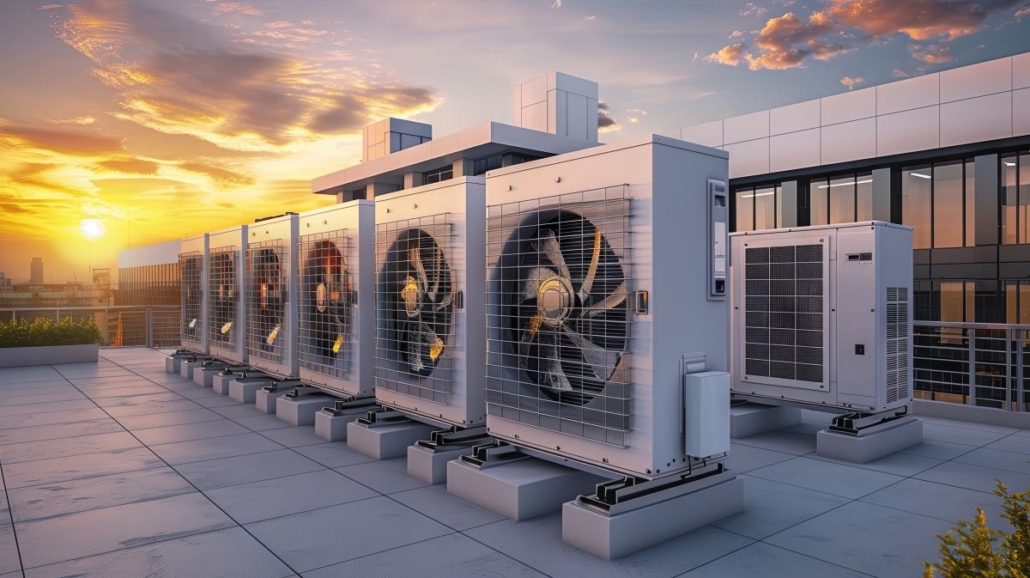
Navigating evolving challenges in HVAC systems
Heating, ventilation, and air conditioning (HVAC) systems are at the center of today’s decarbonization and digitalization agendas. Electrification, rising efficiency standards, and the push toward connected buildings are reshaping how these systems are designed, controlled, and protected.
A shifting HVAC landscape
Several market shifts are increasing control and protection complexity and, in the process, reshaping HVAC system design.
Decarbonization and electrification are accelerating the transition from combustion-based heating to electric heat pumps in commercial, residential and industrial applications, where heat pumps are increasingly replacing process heat that previously relied on fossil-fuel combustion. This shift increases aggregate electrical load density and short‑circuit capacities at the panel level, placing greater emphasis on precise motor control and coordinated protection for compressors, pumps, and fans.
Tighter efficiency regulations are also raising the performance bar. In North America, SEER2, EER2, and HSPF2 minimums now shape equipment design and selection, with higher regional minimums and more realistic test procedures that reflect real ductwork and static pressure. To hit these targets, OEMs are moving from fixed-speed architectures to variable‑speed, inverter‑driven topologies, which improve part‑load efficiency but introduce new fault modes, harmonic content, and device coordination challenges between drives, upstream protection, and contactors.
Low‑GWP (Global Warming Potential) refrigerants are becoming standard, with A2L refrigerants like R‑454B replacing legacy HFCs in new systems. Categorized as flammable, these refrigerants often trigger wholesale system redesigns: coil ratings, motor sizes, and control sequences shift, which impacts short‑circuit ratings, coordination studies, and thermal management requirements inside the panel — and brings every component into scope under standards such as UL 60335-2-40. At the same time, equipment miniaturization and modular architectures are increasing power density in ever-smaller enclosures, making heat dissipation and clearances harder to manage while still complying with UL, IEC, and regional standards.
Smart and connected systems are now a top priority for building owners, who expect HVAC equipment to integrate seamlessly with building automation systems (BAS) and expose rich diagnostics, trending, and predictive maintenance data. The rapid growth of IoT and BAS integration means control architectures now include more sensors, I/O, communication gateways, and software‑configurable logic that must be powered, protected, and laid out in ways that remain serviceable and scalable across product families. This shift raises expectations for communication‑ready control panels, standardized protocols, and more sophisticated sensing and protection strategies that can support data‑driven operation over the equipment life cycle.
Increased supply chain volatility is forcing HVAC OEMs and panel builders to rethink how they source components. Frequent or lingering material shortages and shipping disruptions make it risky to rely on unvetted suppliers or one‑off parts that cannot be easily substituted. In response, engineering teams are standardizing on modular panel architectures and partnering with well‑vetted North American single‑source suppliers with established reputations to help them meet timelines as well as performance and compliance requirements.
Implications for OEMs and panel builders
For OEMs and panel builders, today’s market shifts show up as sharper design, reliability, and compliance pressures—especially in control and protection.
Rising design complexity means panels must coordinate variable-frequency drives, contactors, softstarters, overload relays, breakers, disconnects, and BAS‑ready I/O in compact footprints while still meeting efficiency and safety rules. Variable‑speed compressors and fans introduce harmonics and non‑sinusoidal currents, so HVACR drives need to be selected and coordinated with HVAC contactors, overload protection, and upstream breakers as a system—not as standalone parts.
At the same time, reliability expectations are climbing. High inrush during compressor starts, frequent cycling, and higher load density can quickly stress contactors that are not built for HVAC duty, resulting in nuisance trips and premature failures. Using HVAC‑grade thermal overload relays and contactors designed for compressor and fan applications helps maintain selectivity and protect motors under real operating conditions.
More power in smaller enclosures also magnifies thermal management and coordination challenges. Compact, low‑loss miniature circuit breakers (MCBs) support higher power density without sacrificing protection performance, while thoughtful panel layouts help keep internal temperatures under control and simplify service.
Compliance and operational risk are never far from the surface. Each platform must navigate UL, IEC, and regional standards while delivering high uptime and predictable maintenance. Poor coordination between drives, contactors, overload relays, and circuit protection can result in failed approvals, unexpected outages, and higher service costs.
To stay ahead, many OEMs are standardizing on modular control and protection architectures built around HVAC‑grade components—such as definite purpose contactors, coordinated overloads, and appropriately rated MCBs—supported by digital engineering and simulation tools. ABB’s HVAC low-voltage portfolio brings these elements together for chillers, air handling units, heat pumps, and other critical systems, helping design teams reuse proven solutions and bring new variants to market faster, with less engineering rework.
6 key takeaways for HVAC OEMs
As HVAC systems evolve, control and protection solutions must keep pace. Here are six design priorities to consider:
- Prioritize component selection that reflects HVAC duty cycles, high inrush currents, and frequent switching.
- Embrace an integrated design mindset that considers electrical, thermal, and mechanical aspects together, rather than treating panel protection, control, and layout as separate disciplines.
- Use modular, standardized panel architectures built around HVAC-grade contactors, overloads, breakers, and control interfaces to simplify compliance and accelerate product refreshes when regulations change.
- Design for BAS connectivity from the outset, ensuring drives, contactors, and controllers support open protocols and expose the diagnostics, trends, and status data needed for remote monitoring and predictive maintenance.
- Leverage digital engineering and simulation tools — supported by suppliers with HVAC application expertise — to validate performance and compliance early in the design cycle, minimizing rework and field issues.
- Choose suppliers wisely, favoring well-vetted North American partners with strong quality records and multiple HVAC-grade options, so panel designs stay resilient when supply chain disruptions arise.
Building the next generation of HVAC systems
In a market defined by electrification, higher efficiency standards, low‑GWP refrigerants, and connected buildings, robust control and protection are no longer just design details; they are strategic enablers of reliable, efficient, and future‑ready HVAC systems. By pairing sound engineering practices with a coordinated portfolio of HVAC‑grade drives, contactors, overloads, and circuit protection, ABB helps OEMs and panel builders turn these challenges into differentiated, compliant solutions that are ready for what’s next.
Authors

Albert Martinez, Global Market Development Manager · ABB Electrification Business
Albert Martinez is a Global Market Development Manager at ABB Electrification Business, where he focuses on helping OEMs upgrade their systems using ABB’s control solutions. Albert holds a Master’s in Industrial Engineering from ETSEIT and brings a background spanning product management, marketing, and business development across the industrial automation and control sectors.

Kim Fairley, MBA, OEM Marketing Director · ABB Electrification Business
Kim Fairley, MBA, is OEM Marketing Director at ABB Electrification Business, where she leads OEM marketing strategy focused on driving growth across OEM channels and customer segments in the North American electrification market.