
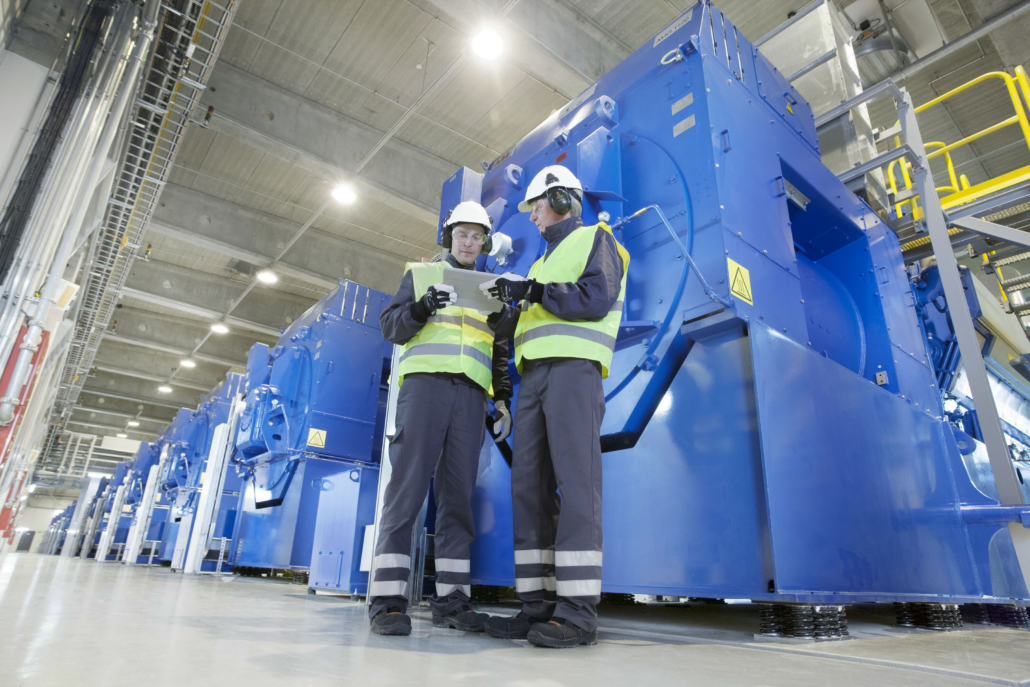
Genset control components for reliable backup power
For mission-critical facilities — from hospitals to data centers — backup power reliability depends on more than the generator itself. Choosing integrated genset control components reduces failure risk, simplifies installation, and keeps operations running when the grid cannot.
Genset control components are the integrated electrical devices — including automatic transfer switches, monitoring relays, pilot devices, and power supplies — that manage how a generator set detects, responds to, and sustains backup power during an outage. For mission-critical facilities such as data centers, hospitals, and semiconductor fabs, the reliability of these components determines whether backup power engages correctly when it matters most.
When a genset fails to engage during a power outage, the consequences can range from costly downtime to genuine safety risks. The difference between a reliable backup power system and an unreliable one often comes down to the quality and integration of its control components.
As the grid ages and demand for electricity sometimes outstrips supply, power outages have become an unfortunate fact of life. Gensets — compact systems that combine an engine and a generator to produce electrical power — are a popular backup solution for industries where outages can threaten not only the business but also lives: data centers, healthcare, process manufacturing, and semiconductor fabrication among them. Weather and natural disasters cause nearly 87% of U.S. outages according to one estimate, but equipment failure accounts for an additional 11.9% — and that’s the portion integrated control components directly address.
What are the 5 essential genset control components?
To ensure backup power reliability, the genset must be supported by an integrated network of advanced components designed to work together. Dozens of components have a role to play, but it helps to break them down into five main categories.
1. Automatic Transfer Switches (ATS)
In the event of a loss of power, the ATS coordinates when to engage or disengage the genset based on real-time power status. This synchronization is pivotal for maintaining uninterrupted power and reducing the risks associated with outages or power quality issues.
More advanced ATS, such as the ABB TruONE™, further enhance power reliability by integrating the switch and the controller into a single unit. Eliminating external wiring between components significantly reduces potential points of failure to ensure reliable operation during critical power transitions. This integration also simplifies the installation process, making it up to 80% faster and increasing safety by minimizing the exposure of maintenance personnel.
2. Control power components
Controlling power requires a wide range of components, such as monitoring relays, and pilot devices. Of course, all of these components require power to operate and the choice of power supply matters. More advanced power supply solutions provide additional protection through isolation of the control voltage and can provide power buffering as well. This helps improve power stability during voltage dips and sudden high-load situations.
3. Command and signaling components
This category of components includes all the manual devices used to control the flow of power, e.g., pushbuttons, selector switches, and emergency stops. Many systems also include various alarms and lights to indicate certain modes or the status of the equipment.
In addition, various types of relays are used to control the power flow to protect people and equipment:
- Interface relays provide isolation and circuit manipulation by engaging or disengaging their internal coils.
- Time relays are specialized electromechanical or electronic devices used to control the timing of operations in electrical systems. For example, an industrial generator may require a cool down phase before powering down completely.
4. Motor Protection
These components provide local protection by relaying information to control devices. For instance, if a genset overheats it can lose efficiency or even fail completely. In this category, you commonly find thermistor, phase, voltage, and temperature monitoring relays.
5. Monitoring
Tying everything together, we have monitoring devices, such as ABB’s Lite Panel Pro, that allow operators to keep an eye on what’s happening across the system remotely and in real time. While some of the functions we’ve already talked about are initiated automatically, e.g. safety measures that are taken when parameters are detected outside operating norms, remote monitoring devices and the analytical tools they support are the key to implementing predictive maintenance strategies for optimizing power reliability and safety.
Why integration matters for genset reliability
Industrial activity in the U.S. is an upswing, but industry analysts warn that the national grid may not be ready to handle the increased load. Add on the increased demand from everything from data center power consumption to a surge in electric vehicles and power outages may be inevitable. Gensets and other backup solutions serve a critical need.
Choosing advanced power components that are designed to work together can help ensure a smooth transition to backup sources of power for mission-critical applications. While these components do not necessarily need to come from a single vendor, a single-source solution often means the integration between these components have been pretested, simplifying implementation and troubleshooting.
See related blog post “UL 1008 testing requirements and ATS ratings: A technical guide”
Authors

Babu Chinnasamy, Product Marketing Manager · ABB Electrification Business.
Babu brings 27 years of electrical industry experience spanning new product development, systems engineering, and product marketing. For the past nine years he has focused on product marketing at ABB, and currently manages the automatic transfer switch product line. He holds an M.S. in Management with a concentration in Technology & Innovation from Rensselaer Polytechnic Institute and a B.E. in Mechanical Engineering from Thiagarajar College of Engineering.

Matt Darroch, Product Marketing Manager · ABB Electrification Business.
Matt joined ABB in 2019, where he manages product marketing for pilot devices, electronic relays and controls, and limit switches. He also co-leads ABB’s MOEM initiative, focused on motor starting and safety solutions for machinery and equipment.